Dose-Dependent Effects of Zinc Oxide Nanoparticles on Growth, Antioxidative Enzymes, and Yield of Pearl Millet
Research Article
DOI:
https://doi.org/10.21276/pt.2025.v2.i4.9Keywords:
Antioxidative enzymes, Foliar application, Sustainable agriculture, Zinc fertilizer, Zinc oxide nanoparticlesAbstract
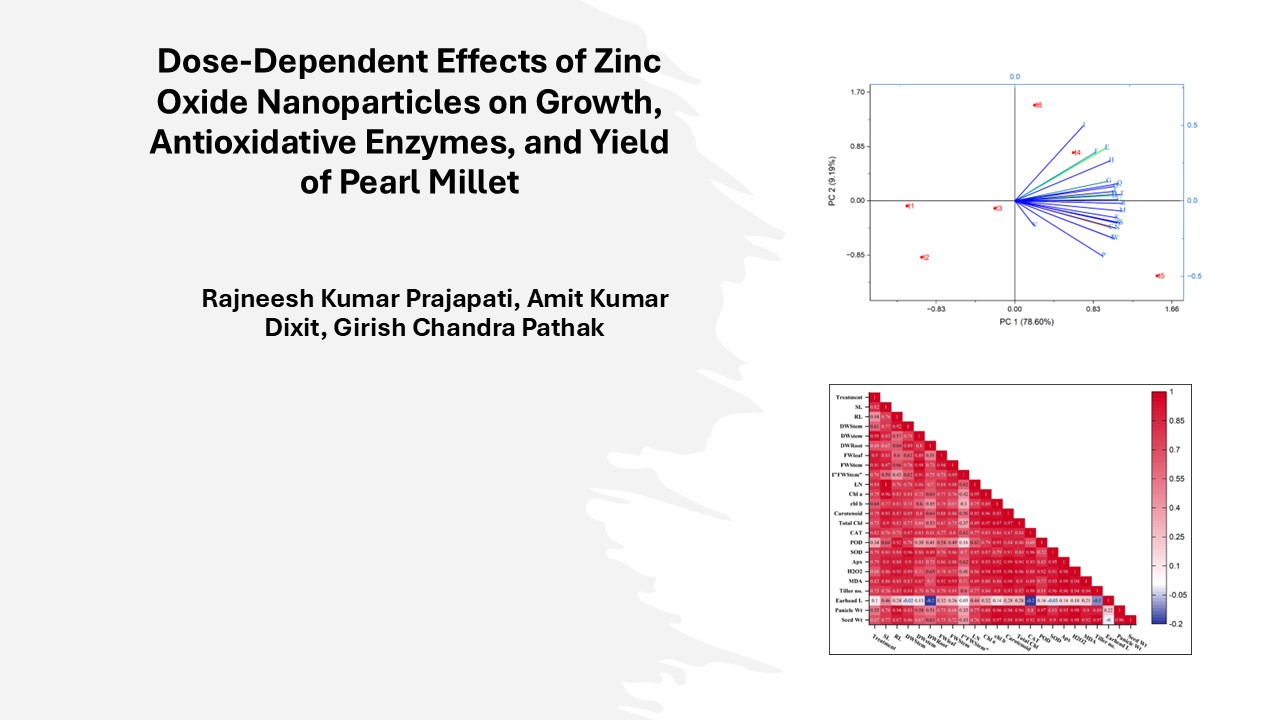
Zinc is an essential micronutrient required for optimal plant growth, metabolism, and yield; however, zinc deficiency remains a major constraint to cereal production under intensive agricultural systems. Recent advances in nanotechnology have highlighted zinc oxide nanoparticles (ZnO-NPs) as a promising alternative to conventional Zn fertilizers due to their enhanced solubility, bioavailability, and targeted delivery. The present study evaluated the dose-dependent effects of ZnO-NPs on growth performance, antioxidative enzymes activity, and yield attributes of pearl millet [Pennisetum glaucum (L.) R. Br.]. Plants were treated with graded concentrations (0.001, 0.01, 0.1, 1, 2 and 10 ppm) of ZnO-NPs through foliar application, and their effects were compared. Plants exhibited a concentration-dependent response to ZnO nanoparticle application, with significant enhancement in vegetative growth, chlorophyll biosynthesis, and enzymatic antioxidant defense up to 2 ppm. However, at higher concentrations (10 ppm), vegetative growth and chlorophyll biosynthesis declined, indicating the onset of phytotoxic effects. The application of ZnO nanoparticles at 2 ppm was the most effective treatment, significantly enhancing shoot and root biomass, chlorophyll content, tiller production, panicle weight, and seed weight compared to other concentrations. Growth parameters, including plant height, biomass accumulation, and leaf area, were significantly enhanced at optimal concentrations of ZnO nanoparticles (ZnO-NPs). Furthermore, the activities of key antioxidant enzymes—superoxide dismutase (SOD), catalase (CAT), and peroxidase (POD)-were markedly increased, indicating improved regulation of oxidative stress and enhanced cellular protection. However, higher doses of ZnO nanoparticles (ZnO-NPs) led to a decline in physiological performance, indicating potential phytotoxic effects at excessive concentrations. Yield attributes, such as grain weight and panicle length, were optimized at moderate ZnO-NP application rates. Overall, the findings demonstrate that judicious application of ZnO-NPs can improve growth, antioxidant defense, and yield of pearl millet, highlighting their potential role in sustainable micronutrient management.
References
References
Dimkpa C O, Bindraban P S. Nanofertilizers: New products for the industry. Journal of Agricultural and Food Chemistry, 2018; 66(26): 6462–6473. https://doi.org/10.1021/acs.jafc.7b02150
De Groote H., Tessema M, Gameda, S, & Gunaratna NS. Soil zinc, serum zinc, and the potential for agronomic biofortification to reduce human zinc deficiency in Ethiopia. Scien. Rep. 2021; 11(1): 8770. https://doi.org/10.1038/s41598-021-88304-6
Nithiyanantham S, Kalaiselvi P, Mahomoodally MF, Zengin G, Abirami A, Srinivasan G. Nutritional and functional roles of millets-a review. J. Food Biochem. 2019; 105: 862-870. https://doi.org/10.1111/jfbc.12859
Anitha S, Kane-Potaka J, Tsusaka TW, Botha R, Rajendran A, Givens DI. Asystematic review and meta-analysis of the potential of millets for managing and reducingthe risk of developing diabetes mellitus. Front Nutr. 2021; https://doi.org/10.3389/fnut.2021.687428
Kankarwal P, Gali SP, Meenatchi PR, Singh P. Millets’ role in addressing malnutrition and ensuring food security in a changing climate in: Enhancing crop resilience: Advances in climate smart crop production technologies. eds. Kumar A, SahRP, Gowda B,G., Dey JK, Debnath A, Das B. BIOTICA. Edu Publications LL: Ganki, Tripura, India. 2024; 113–143. https://doi.org/10.54083/978-81-947739-1-7-8
Dubey D, Singh N, Prajapati R K, Dixit AK, Pathak GC. Nano fertilizers: A sustainable solution for combating abiotic stress in crops. Advanced Researches in Agricultural Sciences. 2025; Volume 1, ISBN 978-81-976294-0-2: 89-100. https://doi: 10.37446/volbook092024/89-100.
De La Torre-Roche R, Cantu, J, Tamez, C, Zuverza-Mena, N, Hamdi, H, Adisa, I O, White, J C. Seed biofortification by engineered nanomaterials: a pathway to alleviate malnutrition. Journal of Agricultural and Food Chemistry, 2020; 68(44): 12189-12202. https://doi.org/10.1021/acs.jafc.0c04881
Tiwari YK, & Yadav SK. Effect of high-temperature stress on ascorbate-glutathione cycle in maize. Agri. Res., 2020; 9: 179-187.https://doi.org/10.1007/s40003-019-00421-x
Disante KB, Fuentes D, Cortina J. Response to drought of Zn-stressed Quercus suber L. Seedlings. Env.Exp.Bot.2010; 70:96-103.https://doi.org/10.1016/j.envexpbot.2010.08.008
Tavallali V, Rahemi M, Eshghi S, Kholdebarin B and Ramezanian A. Zinc alleviates salt stress and increases antioxidant enzyme activity in the leaves of pistachio ( Pistacia vera L.) seedlings, Turk. J. Agr. Forest. 2010; 34(4): 349-359. https://doi.org/10.3906/tar-0905-10
Kasim WA. Physiological consequences of structural and ultra-structural changes induced by Zn stress in Phaseolus vulgaris.I. Growth and Photosynthetic apparatus. Int. J. Bot. 2007; 3(1):15-22.https://doi.org/10.3923/ijb.2007.15.22
Peck AW, Mc Donald GK. Adequate zinc nutrition alleviates the adverse effects of heat stress in bread wheat. Plant Soil. 2010; 337:355-374..https://doi.org/10.1007/s11104-010-0532-x
Manzoor MA, Xu Y, Lv Z. Nanotechnology-based approaches for promoting horticulture crop growth, antioxidant response and abiotic stresses tolerance. Plant Stress. 2024; 11: 100337.https://doi.org/10.1016/j.stress.2023.100337
Preetha JSY, Sriram D, Premasudha P, Pudake RN, Arun M. Cerium oxide as a nanozyme for plant abiotic stress tolerance: an overview of the mechanisms. Plant Nano Biol. 2023; 6: 100049.https://doi.org/10.1016/j.plana.2023.100049
Schwab F, Zhai G, Kern M, Turner A, Schnoor JL, Wiesner MR. Barriers, pathways and processes for uptake, translocation and accumulation of nanomaterials in plants critical review.Nanotoxicology.2016;10(3):25778https://doi.org/10.3109/17435390.2015.1048326
Smijs TG, Pavel S. Titanium dioxide and zinc oxide nanoparticles in sunscreens: focus on their safety and effectiveness, Nanotechnology, Science and Applications. 2011; 4: 95–112 https://doi.org/10.2147/nsa.s19419
Ruszkiewicz J A, Pinkas A, Ferrer B, Peres T V, Tsatsakis A, Aschner M. Neurotoxic effect of active ingredients in sunscreen products, a contemporary review, Toxicology Reports. 2017; 4, 245–259 https://doi.org/10.1016/j.toxrep.2017.05.006
Seleiman MF, Ahmad A, Martin L Battagliac H, Muhammad B, Bushra AA, Khan N. Zinc oxide nanoparticles: A unique saline stress mitigator with the potential to increase future crop production. South Afr. J. Bot. 2023; 159:208–218. https://doi.org/10.1016/j.sajb.2023.06.009
Tarafdar J C, Raliya R, Mahawar H, & Rathore I. Development of Zinc Nanofertilizer to Enhance Crop Production in Pearl Millet (Pennisetum americanum). Agricultural Research, 2014; 3(3): 257–262. https://doi.org/10.1007/s40003-014-0113-y
Wang R, Mi K, Yuan, X. Zinc Oxide Nanoparticles Foliar Application Effectively Enhanced Zinc and Aroma Content in Rice (Oryza sativa L.) Grains. Rice 2023; 16, 36. https://doi.org/10.1186/s12284-023-00653-0
Faizan M, Hayat S, Pichtel J. Effects of zinc oxide nanoparticles on crop plants: A perspective analysis. Sustainable Agriculture Reviews, 2021; 53: 171–193. https://doi.org/10.1007/978-3-030-33996-8_4
Hewitt, E. J. (1952). Sand and water culture methods used in the study of plant nutrition. Technical Communication No. 22, Commonwealth Bureau of Horticulture and Plantation Crops, East Malling, Kent.
Pathak G C, Pandey N, Sharma C P. (2005). Zinc regulation of antioxidant defense in green gram (Vigna radiata L.). J. Plant Biol. 32 (3): 211-216.
Lichtenthaler H K, Wellburn A R. Determinations of total carotenoids and chlorophylls a and b of leaf extracts in different solvents. Biochemical Society Transactions, 1993; 11(5): 591–592.https://doi.org/10.1042/bst0110591
Euler H, Josephson K. The catalase reaction. Biochemische Zeitschrift, 1927; 184: 489–497. https://doi.org/10.1515/bchm2.1927.166.4-6.294
Luck H. Peroxidase. In H. Bergmeyer (Ed.), Methods of Enzymatic Analysis (pp. 895–897). Academic Press 1963;..https://doi.org/10.1016/b978-0-12-395630-9.50159-6
Beauchamp C, Fridovich I. Superoxide dismutase: Improved assays and an assay applicable to acrylamide gels. Analytical Biochemistry, 1971; 44(1): 276–287. https://doi.org/10.1016/0003-2697(71)90370-8
Nakano Y, Asada K. Hydrogen peroxide is scavenged by ascorbate-specific peroxidase in spinach chloroplasts. Plant and Cell Physiology, 1981; 22(5): 867–880. https://doi.org/10.1093/oxfordjournals.pcp.a076232
Brennan T, Frenkel C. Involvement of hydrogen peroxide in the regulation of senescence in pear. Plant Physiology, 1977; 59 (3): 411–416.https://doi.org/10.1104/pp.59.3.411
Heath R L, Packer L. Photoperoxidation in isolated chloroplasts. I. Kinetics and stoichiometry of fatty acid peroxidation. Archives of Biochemistry and Biophysics, 1968; 125 (1): 189–198.https://doi.org/10.1016/j.abb.2022.109248
Prasad T N V K V, Sudhakar P, Sreenivasulu Y, Latha P, Munaswamy V, Reddy K R, Sreeprasad T S, Sajanlal P R, Pradeep, T. Effect of nanoscale zinc oxide particles on the germination, growth, and yield of peanut. Journal of Plant Nutrition, 2012; 35(6): 905–917. https://doi.org/10.1080/01904167.2012.663443
Adhikari T, Kundu S, Rao A S. Zinc oxide nanoparticles as fertilizer for the germination, growth, and yield of maize. Soil Science and Plant Nutrition, 2016; 62(3): 341–348.https://doi.org/10.1080/01904167.2015.1023562
Cakmak I. Enrichment of cereal grains with zinc: Agronomic or genetic biofortification? Plant and Soil, 2008; 302: 1–17.https://doi.org/10.1007/s11104-007-9466-3
Ruttkay-Nedecky B, Krystofova O, Nejdl L. Nanoparticles based on essential metals and their phytotoxicity. J Nanobiotechnol. 2017; 15: 33 https://doi.org/10.1186/s12951-017-0268-3
Pandey N, Pathak G C, Sharma C P. Zinc is critically required for pollen function and fertilisation in plants. Plant J. Trace Element Med. Biol. 2006; 20 (2): 89-96. .https://doi.org/10.1016/j.jtemb.2005.09.006.
Downloads
Published
Data Availability Statement
The data that support the findings of this study are available from the corresponding author upon reasonable request.
Issue
Section
License
Copyright (c) 2025 Rajneesh Kumar Prajapati, Amit Kumar Dixit, Girish Chandra Pathak (Author)

This work is licensed under a Creative Commons Attribution-NonCommercial 4.0 International License.
Copyright and License Terms
Authors who publish with this journal agree to the following terms:
- Authors retain the copyright to their work and grant the journal the right of first publication. The work is simultaneously licensed under a Creative Commons Attribution License permitting others to share it with proper acknowledgement of the authorship and its original publication in this journal.
- Authors may enter into additional, non-exclusive agreements for distributing the published version of their work (e.g., depositing it in an institutional repository or including it in a book), provided they acknowledge that the work was first published in this journal.
Open Access Policy
License
PhytoTalks is an open-access journal, allowing readers to access all published articles without registration. All articles are distributed under the Creative Commons Attribution License (CC Attribution 4.0), which permits unrestricted use, distribution, and reproduction in any medium, provided the original author and source are properly credited. (https://creativecommons.org/licenses/by/4.0/).
License summary:
This license allows others to:
-
Share — copy and redistribute the material in any medium or format
-
Adapt — remix, transform, and build upon the material for any purpose, even commercially
Under the following terms: -
Attribution — appropriate credit must be given, a link to the license provided, and indication if changes were made.
Author Warranties
By submitting a manuscript to PhytoTalks, authors confirm that:
-
The work is original and does not infringe any copyright, trademark, patent, or other rights of third parties.
-
The work has not been published elsewhere (except as a preprint) and is not under consideration by another publication.
-
All necessary permissions for any third-party materials used in the manuscript have been obtained.
Citation Policy
When using or citing articles from PhytoTalks, proper attribution must be given to the original authors and the source, including a DOI link where available.

![Announcement: Special Conference Issue of Phytotalks We are pleased to announce that Phytotalks will publish a special issue featuring select peer-reviewed papers from the Third International Conference on Plant Functional Biology, an esteemed international gathering of experts in Plant Science]. This special issue will highlight cutting-edge research and innovative developments presented at the conference, offering our readers valuable insights into the latest advancements in the field. Stay tuned for this upcoming edition, which reflects our continued commitment to showcasing high-quality, impactful research.](https://phytotalks.com/public/site/images/afrozalam/img-20250701-wa0010.jpg)